Showing posts with label Universal AI. Show all posts

Saturday, July 19, 2025

// // Leave a Comment

Algorithmic Complexity - Appendix to The Prophets of the Thinking Machines


Algorithmic Complexity

Appendix to
The Prophets of the Thinking Machines:
Artificial General Intelligene and Transhumanism

History, Theory and Pioneers
Past, Present and Future
by Todor Arnaudov


Edition: 30.7.2025 (34 pages)
Edition
: 20.7.2025 (32 pages)
Edition
: 19.7.2025 (30 pages)
Edition: 18.7.2025 (27 pages) 

http://twenkid.com/agi
https://github.com/twenkid/sigi-2025
#complexity #сложност 


©Authors:  The authors of all cited and reviewed works, such as:
Hector Zenil, Felipe Abrahao, Andrey Kolmogorov, Gregory Chaitin, Ray Solomonoff, Leonid Levin; Charles Benett, David Deutsch, Nicolas Gauvrit, Jesper Tegnér, Leong Ting Lui, Santiago Hernández-Orozco, Jean-Paul Delahaye, Cristian S. Calude, Gordana Dodig-Crnkovic, Oliver Korten Noam Nisan, Avi Wigderson, Martin Davis, Alexander Shen, Marvin Minsky et al., ; various encyclopaedic sources such as Wikipedia etc.
… & Todor Arnaudov – author of The Prophets of the Thinking Machines and editor, summarizer, introductory texts, notes and author of the contextual reviews and mini-sub-articles.


Read the paper at:
https://twenkid.com/agi/Algorithmic-Complexity_Prophets-of-the-Thinking-Machines-18-7-2025.pdf   (32 pages)

Or from the SIGI-2025 github's page.


(...)


One specific reason for compiling this work now was that I recently discovered a paper from the circle of Hector Zenil about the SuperARC[1] test, and then a recent strategic program paper about the Simulation Intelligence[2]. I decided to refresh and deepen my knowledge by doing a literature review, using Hector’s works as a starting point[3].
            This work intends to be food for thought for readers who also want to improve and widen their knowledge. Other goals are to share my comments and additions to some of the reviewed ideas from the papers and in the context of The Prophets… – to shed light on ...


[1] See below. This paper has technical and extensive continuations of generalizations done also in TUM in the early 2000s

[2] Simulation Intelligence: Towards a New Generation of Scientific Methods Alexander Lavin, David Krakauer, Hector Zenil et al., 2021/2022, https://arxiv.org/abs/2112.03235

[3] Part of the reviews here are included also in the bigger appendix #Listove which has broader and interdisciplinary scope and currently is bilingual - Bulgarian and English.


(...)

[This work is a continuation of the Lecture #4 from the AGI course] 

Complexity and The Universe Computer from the “Sacred Computer”

* World’s first university course in Artificial General Intelligence, Plovdiv 2010, 2011,
https://artificial-mind.blogspot.com/2010/04/universal-artificial-intelligence.html
https://research.twenkid.com/agi/2010/ https://research.twenkid.com/agi/2010/Complexity_Probability_Chaos_10-2010_MTR.pdf

* Lecture slides (Bulgarian):  Complexity and Theory of Information. Probability Theory – statistical (empirical) probability. Chaos Theory. Systems Theory. Emergent functions and behavior. Universe as a computer – digital physics. Algorithmic Probability. Kolmogorov's Complexity and Minimum Message Length. Occam's Razor.  (slides originally in Bulgarian)

* Definition of Machine Intelligence, Legg and Hutter, 2007 – Slides for the course:
Bulgarian: “Универсална интелигентност: Дефиниция на агента на Маркус Хутер”
по работата: Universal Intelligence:”

https://research.twenkid.com/agi/2010/Intelligence_by_Marcus_Hutter_Agent_14_5_2010.pdf
* Slides in English “Universal Intelligence According to Marcus Hutter's Definition”
https://research.twenkid.com/agi/2010/en/Machine_Intelligence_Hutter_Legg_Eng_MTR_Twenkid_Research.pdf

(...)


Overview of Basic Concepts about Turing Machines and Computation

            A tape, divided into cells; a head; state register, a finite table of instructions: given the state and the symbol that is read from the tape (...)


Selected papers, summaries and notes in Algorithmic Complexity, Randomness etc.

(...) 

Read More

Wednesday, January 23, 2013

// // Leave a Comment

New Treatise On Intelligence Coming. Domain Blindess Issues vs Truly General Versatile Intelligence. Comments on Kurzweil's Latest Book. Artistic News - a new Short Film, My Father's Latest Exhibition of Portraits

A commentary on a critique about Kurzweil's latest book:
http://www.newyorker.com/online/blogs/books/2012/11/ray-kurzweils-dubious-new-theory-of-mind.html

"...Kurzweil doesn’t know neuroscience as well as he knows artificial intelligence, and doesn’t understand psychology as well as either. (And for that matter he doesn’t know contemporary A.I. as well as the A.I. of his heyday, when he was running his companies thirty years ago.)
To truly reverse-engineer the human mind, we may need a real consilience, to borrow a word from the Harvard biologist E. O. Wilson, a coming together of workers in A.I. with researchers who study the human mind from a wide range of perspectives—neuroscientists and cognitive psychologists, and maybe even artists, musicians, and writers, too. The challenge of figuring out how the mind works is too complicated for even the smartest of entrepreneurs to solve on their own.
Gary Marcus, a professor of psychology at N.Y.U., is the author of “Guitar Zero: The Science of Becoming Musical at Any Age” and “Kluge: The Haphazard Evolution of the Human Mind.” ..."

Read more: http://www.newyorker.com/online/blogs/books/2012/11/ray-kurzweils-dubious-new-theory-of-mind.html#ixzz2IjNiQtAO

Here I am... I am also "even an artist, musician, writer..." (and a bunch of all kinds of others) + the researcher and technical part, but apparently until I get rich/climb the social rank system or implement practical systems, that has no value in the world occupied by evaluators who are multi-domain and cross-domain blind. Until that time - nobody even notices that you existed.

And the mass audience - it doesn't even realize, that it doesn't applaud most the smartest genii of its time, but the ones which are promoted by the strongest media of the time, especially since it is not qualified enough to judge the work in its technical aspects. (See "Issues with like/dislike voting (...)" in a recent publication, and also an upcoming one.)

The domain blindness is one of many concepts from an upcoming new major treatise (I'll keep the title secret for now), which I've started as an answer to the paper on Musical Beauty and Compression, but it naturally grew in all directions and the methods that I apply need a big enough exposition and integration. It's already many times longer than a conference paper, it might be also a multimedia work, maybe even demos of basic implementations of algorithms, not just a paper. There's also a discussion regarding social biases and confusions about intelligence. "And a lot of stuff."

It would be a sort of "Twenkid's Theory of Mind and Universe" or something, a continuation of my classical period works, the "Teenage Theory of Mind and Universe".

Unfortunately I don't have a lot of time slots lately for the paper, been involved with other task. If I find a time-slot, I will also share some notes on the matches from the works from my "Teenage Theory of Mind and Universe" to Hawkins' "On Intelligence".

I thought about sharing a short story about what it's like to do diverse polymath stuff, who may attention explores enormous amount of topics in a short time, maybe next time.

***

By the way, I had some fun lately producing a new comedy short (micro) film lately, but I've still not published it for free viewing - only in "selected theaters" with excellent reviews from the viewers.


Just to illustrate what a "domain blind" research of intelligence cannot sense, while a "seeing" one senses and understands.

Even in that tiny little movie I've been:

- Writer (it's a tribute, most of the script is borrowed/adapted/selected, but it also has to be selected and adjusted in order to be coherent etc.)
- Director
- Director of Photography and Camera Operator (framing, light selection - as long as the spartan conditions and equipment allowed, you'll see in the movie)
- Author and Performer of the Original Music (it's simple, it probably matches some "standard" one, but it's not intended/I am not aware of, it was improvised on the keyboard) - keyboard, and electric guitar and bass (from a 2012 rock piece of mine)
- Actor in ~6 roles, in non-native language, with 2 different accents and voice-alterations (most are very short, due to the length of the film)
- Juggler (5 beanbags, very low and quick throws)
- Video Editor/Compositor
- Sound Recordist and Editor
- Sound Effects Maker (including with my mouth :) )
- Wardrobe and Property Master
- "Production Designer"
- Author of the Original Video Editing Software - I've designed and developed it myself (you know about it - it requires from me to develop some crucial tools for cinematic magic, and this film again reminded me that I should find time for it).

I may have missed something.

IMHO that's one example of "general intelligence", in combination with other artistic and scientific and technical domains where I am proficient - a versatile, universal intelligence, it includes and implies versatile capabilities to learn and understand and master virtually any possible target domain.

The above is related to another discussion from the upcoming treatise, a new iteration over what general intelligence is  and about nuances regarding "human level intelligence" and its testing. I make a distinction between truly general intelligence and another type which is often confused and is a subset, lexically close and a  part of GI, but much narrower.

Finally, enjoy the latest exhibition of graphical portraits by my father Iliya, he's a really talented artist:

http://twenkid.blogspot.com/2012/11/2012.html


Read More

Thursday, April 21, 2011

// // Leave a Comment

GAI and GAI Conferences and "AI: A Modern --Sorry-- Post-Mortem Approach"

Feel welcome: http://epia2011.appia.pt/

Well, congratulations for the topics and for those guys reforming, but the term is ridiculous. It's obviously coined by orthodox scientifical AI-niks, who're reforming, while keeping their scientific roots (means citations, publications in "high-impact journals" etc.).

I'd stick to the terms AGI and UAI, like in Bulgarian I prefer "УИР" (UIR - Universalen Izkustven Razum) which encompasses both, instead of "УИИ" (UII - "Intelekt"). One of the simple practical reasons is that "УИИ" (UII) sounds too close to "хуй" (HUY) ~ it means "D." English word starting with dic*.

Come on!... :)

From the site:

"The importance of Artificial Intelligence in Portugal is visible by the number of PhDs (over 100), the sheer number of researchers ..."

Good... I'm not saying this for the first time, like for example about the "MEXICA" "creative" framework.

Sorry, but what the h* are all these PhDs doing? Hundreds, thousands, 10s of thousands researchers are supposed to be working on "GAI" projects full-time. Thousands of human-months work. Results? Real things?

Real things and progress is actually coming from non-PhDs, such as formally electrical engineer and neuroscientist Jeff Hawkins, or mathematics and physics PhDs, such as M. Hutter, J.Schmidhuber and B. Goertzel.

This is not surprising - as another non-AI-PhD from the AGI community says, AI belongs (mostly) to "tinkerers" (his term). Check out too see more clearly what I mean:
- Whats_wrong_with_NLP_links.htm
- MEXICA: Creativity Disappointment
- B. Kazachenko: Intelligence by definition

This reminds me that recently I found a video lecture by one of the authors of the notorious "classics" in AI: "AI: A Modern Approach", surprisingly mainly on NLP, collocations and stuff, pretending to be new directions in AI or something...

Very smart, funny and high-status guy, obviously, but I have never had patience to give his book a try, I just knew it's "classics", partially because long time ago I started to distinguish myself from "AI", insisting that if all that junk is called "AI", the least thing one could do is to coin a non-polluted term and stay away.

Now I glanced the content of this "classics" and saw I've not mistaken not reading it... Sorry, but I didn't see anything "modern" in a 1000 pages of random high-level non-scaling really classical methods (except a few chapters on agents and machine learning).

Dear respectful high status scientists and directors - give us results, please. Pretentious pedantically written PhD theses and a large number of publications or citations are meaningful status-symbol per se mostly in the pretentious environment of the scientific conferences and non-specialists surrounding where the only mean for the others to recognize how big researcher you are is to count your publications and citations or how high you are in the science status - PhD student, PhD, Post-Doc, .... Check the links above to understand what's wrong with that.

Read More

Thursday, March 31, 2011

// // 2 comments

IM-CLeVER and iCub - EU Funded Projects - Hierarchical Reinforcement Learning, Abstraction of Sensory Inputs ...

Have you seen this cute little baby robot?


I have heard of it, but checking the aims and basic assumptions of the project from the source pushed me - they're in the right direction and aware of the issues, Juergen Schmidhuber is being one of the leaders.

Another signal that I have to discipline my ass, as well... :)

http://www.im-clever.eu/project/project-description

IM-CLeVeR is supported by the European Commission
under the ‘FP7 Cognitive Systems, Interaction,
and Robotics Initiative’, grant no. 231722.

Start: 01/01/2009 (start of scientific work: 01/05/2009)
End: 30/04/2013
Total duration: 52 months

Total EU Funding: 5.899.884 euros
Total Budget (EU Funding + Cofunding): 7.726.783 euros


Another use of iCub:

Read More

Tuesday, March 29, 2011

// //

Mathematical Theory of Intelligence - Second Course in AGI/UAI at Plovdiv University by Todor Arnaudov (Course Program in English)

Mathematical Theory of Intelligence (AGI/Universal AI)
by Todor Arnaudov
http://research.twenkid.com
http://artificial-mind.blogspot.com

The course was taught to undergraduate students between 1/2011 – 3/2011 at Plovdiv University “Paisii Hilendarski”, Bulgaria, in the Faculty of Mathematics and Informatics. (Originally in Bulgarian, with a lot of additional sugguested materials in English). This was the second AGI/UAI course after "Artificial General Intelligence/Universal Artificial Intelligence" (originally: "Универсален изкуствен разум") from last year; now putting stronger emphasize on the most advanced lectures on theories of intelligence and the common principles, meta-evoltution and Boris Kazachenko's works, now reviewed more thoroughly in class (as far as my understanding and students interest went).

You may find a lot of materials in English and links in this blog. There's somewhat sorted list by topic done for the students, but it might be partially incomplete, because it's not updated immediately with the blog posts. Students are advised to check out the blog for the topics from the first course, which were omitted in the formal program of the second one, such as other AGI researchers work and directions - there was too little time available in class...
I guess the next more updated course is supposed to go even more deeper into formal models, maybe starting with some real basic AGI agents.

I'm preparing to publish slides in English (you can find Bulgarian ones in the course homepage on the top) - especially slides and translation of the old works from my "[Teenage] Theory of Mind/Intelligence and Universe", written between 2001-2004, which years later was how I recognized the "school of thought" I belonged to (see the annotation below).

This course could be taught in English as well, if there's an appropriate demand/place/invitation.


Annotation:

Mathematical Theory of Intelligence
This course is addressed to students who wish to work in the novel interdisciplinary field of Artificial General Intelligence (AGI & UAI) which is building the theoretical foundations and research methodology for the future implementation of self-improving human-level intelligent machines - “thinking machines“ (AI was one of the predecessors of this field, but went into solving too specific problems). The course introduces students to the appropriate foundations in futurology and transhumanism, mathematics, algorithms, developmental psychology and neuroscience in order to finally review some of the current theories and principles of general/universal intelligence from the “school of thought” of researchers such as Jeff Hawkins, Marcus Hutter, Juergen Schmidhuber, Todor Arnaudov and Boris Kazachenko.

Course Program: (as of 11/2010) (Syllabus)

1. What is Universal Artificial Intelligence (UAI, AGI, „Strong AI“, Seed AI). Technological Singularity and Singularity Institute. Transhumanism. Expected computing power of human brain. Attempts for literal simulation of mammalian brain. "Universality paradox" of the brain. Ethical issues, related to AGI.

2. Methodological faults in narrow AI and NLP (Natural Language Processing), reasons for their limited success and limited potential. Review of the history of approaches in (narrow) AI and its failures and achievements up to nowadays. Concepts from AI that are prospective and still alive in AGI, such as probabilistic algorithms, cognitive architectures, multi-agent systems.

3. Mathematics for UAI/AGI: Complexity and information theory. Probability Theory – statistical (empirical) probability. Turing Machine. Chaos Theory. Systems Theory. Emergent functions and behavior. Universe as a computer – digital physics. Algorithmic Probability. Kolmogorov's Complexity and Minimum Message Length. Occam's Razor.

4. Introduction to Machine Learning. Markov's Chains. Hidden Markov Models (HMM). Bayes Networks. Hierarchical Bayes' Networks and Hierarchical HMM. Principles of the algorithms of Viterbi and Baum-Welch (Expectation-Maximization). Prediction as one of the basis of intelligence.

5. Drives of human behavior - behaviorism. Classical conditioning. Operant Conditioning and reinforcement learning as universal learning method for humans and machines. Why imitation and supervised learning are also required for AGI.

6. Introduction to Developmental Psychology (Child Psychology). Stages in cognitive development according to Piaget, and opposing views. First language acquisition. Nature or Nurture issues and how specific cognitive properties, behavior and functions could emerge from a general system.

7. What is intelligence? Thorough review of Marcus Hutter's and Shane Legg's paper “Universal Intelligence: A Definition of Machine Intelligence”. Universal Intelligence of an agent as a capability to predict sequences of actions with maximum cumulative reward. Types of agents in environments of different complexity.

8. Beauty and Creativity as compression ratio progress in the work of Jurgen Schmidhuber.

9. Brain Architecture – functional anatomy of mammalian and human brain. Triune theory - evolution of vertebrate's brain. Neurotransmitters and hormones and their relations to emotions and behavior. Mini-column hypothesis and functional mapping of the neocortex. Attempts for biologically correct simulations of the neocortex such as the BlueBrain project.

10. Evolution in biological, cybernetical and abstract sense: genetic, epigenetic, memetic and its application in design of complex self-organizing systems. Review of Boris Kazachenko's work on meta-evolution as Abstraction of a conserved core from its environment, via mediation of impacts & responses by increasingly differentiated adaptive interface hierarchy. Entropy as equation and increase of order, not increase of chaos.

11. Introduction to the theory of Intelligence by Jeff Hawkins. Modeling the function of human neocortex – the Memory-Prediction Framework and the principles of operation of the Hierarchical Temporal Memory.

12. Introduction to the theory of Intelligence by Todor Arnaudov – mind as a hierarchical system of simulators of virtual universes, that predict expected sensory inputs at different levels of abstraction. Hierarchical prediction/causation of maximum expected reward, where correctness of prediction/causation is rewarding. The Universe as a computer and trend in the evolution of Universe (cybernetical evolution). Proposal for guided functional simulation of the evolution of vertebrates' brain, starting by a general cognitive module that is simpler than mini-column.

13. Theoretical Methodology of Boris Kazachenko. Generalists and specialists, generality vs novelty seeking. ADHD and ASD. Attention, concentration, distractions and avoiding them. Induction vs deduction.

14. Introduction to the theory of intelligence by Boris Kazachenko. Cognition: hierarchically selective pattern recognition & projection. Scalable learning as hierarchical pattern discovery by comparison-projection operations over ever greater generality, resolution and scope of inputs. Importance of the universal criterion for incremental self-improvement. Comparisons of greater power and resulting derivatives, and iterative meta-syntax expansion as means to increase resolution and generality. Boris Kazachenko's Prize for ideas.

15. Summary of the principles of general intelligence in the works of Jeff Hawkins, Marcus Hutter, Juergen Schmidhuber, Todor Arnaudov and Boris Kazachenko: incremental [hierarchical] accumulation of complexity, compression, prediction, abstraction/generalization from sensory inputs. Evidences and real-life examples for the reliability of this principles.

16. Practice in introspection and generalization. Expansion of the scope of cases, where cognitive algorithm is applicable.

17. Exam.

Update from 29/11/2011: Comments on the AGI email list of AGIRI:
John G. Rose ... via jeeves.archives.listbox.com to AGI show details Nov 24 (5 days ago) Great course programs covering AGI summary/introduction, I like the selection of topics discussed. You might consider opening these up online via streaming/collaboration in the future… John ...

Ben Goertzel ... via jeeves.archives.listbox.com to AGI, AGI show details Nov 28 (2 days ago)
Tosh
Looks like a great course you're offering!n FYI ... On your page you note that our 2009 AGI summer school didn't cover jeff Hawkins' work... I can't remember if any speaker mentioned hawkins, but, Allan combs gave some great lectures on neuroscience, which covered hierarchical processing in visual cortex among other topics ;) That AGI summer school presented a variety of perspectives, it wasn't just about open cog and my own views ... But it wasn't heavy on perception-centered AGI... Ben ...

Todor Arnaudov's answers: Thanks, John.

There are materials from the course online (on the blog and on the site); most of the lecture slides and details are only in Bulgarian yet, though. As of collaboration - maybe, as long as I manage to create a team, for the moment I prefer keeping the authorship for myself. ...

Thanks Ben! And thanks for the notes. :)

Ben>That AGI summer school presented a variety of perspectives, it wasn't just about open cog and Ben>my own views ... But it wasn't heavy on perception-centered AGI...

All I knew about the summer school was from the brief web page on your site: http://www.goertzel.org/AGI_Summer_School_2009.htm Hawkins wasn't mentioned in the program, and it sounded reasonable not to be, as he seemed from a distant "school of thought" compared to the lecturers' ones - as far as I knew or assumed theirs.

Ben>I can't remember if any speaker mentioned hawkins, but, Allan combs gave some great lectures on Ben>neuroscience, which covered hierarchical processing in visual cortex among other topics ;)

That's nice (I've noticed neuroscience in the program), but anyway I think HTM and the other sensorimotor topics are more general - memory-prediction framework and the other similar models are supposed/aiming to explain virtually all kinds of cognitive processes with an integral paradigm, and vision is just an example/case. In a POV of schools, there's a distinction whether it's suggested that vision is an example of a general framework, or it's one of the sub-architectures/sub-frameworks for an AGI.
Read More

Thursday, March 24, 2011

// // Leave a Comment

Universal Artificial Intelligence by M. Hutter, Neocortical Mini-Columns in Reinforcement Learning Context, Creativity & Virtual Worlds - at AGI 2010

Selection of recommended talks on AGI 2010 conference:

Marcus Hutter - Universal Artificial Intelligence, AGI 2010


Tutorial on Mini-Column Hypothesis in the Context of Neural Mechanisms of Reinforcement Learning - by Randal A. Koene, AGI 2010


Related to M. Hutter - Jurgen Schmidhuber notices that reinforcement learning needs many steps, many decision points, and marks compression progress as an abstract form of reward for cognitive processes:

Jurgen Schmidhuber-Artificial Scientists Artists Based on the Formal Theory of Creativity, AGI 2010


The following one is mostly to get familiar about the state of the art of Virtual Worlds simulations for AGI - it seems pretty primitive... Taking into account also the demos with reinforcement learning agents in other talks, where the agents play simple games such as Pacman, "Pocman" (partially-observable environment), tic-tac-toe or tank games, or the dogs in Ben Goertzel's demo which learn to carry the object back to their master (coordinates of a bounding rectangle)...

I've been speculating about different virtual world systems for AGI seed AI and other intelligent agents experiments myself, but it was some 6 years ago; wished to start experimenting in formalizing so called my "Teenage Theory of Mind and Universe" and testing it in such worlds, but it was for a short time, and it has left as just ideas because of all the other stuff I had to deal with. However I am back, and certainly there's a lot of work to be done in this field.

Ben Goertzel - Using Virtual Agents and Physical Robots for AGI Research


Some funny closing remarks by Marcus and Ben:


Keywords: neural, mini-column, universal, artificial, intelligence, AGI, UAI, УИР, agents, physics, simulations, reinforcement, learning, AIXI, virtual, worlds, simulators

Read More

Wednesday, March 23, 2011

// // Leave a Comment

News: Official AGI Journal and Independent AGI E-zine

I've been considering founding a sort of independent journal for AGI, where to give some more "formal" shape of works of Boris Kazachenko, myself and other independent researchers, it might be called just "e-zine". [ It was "formally declared" a month later here. ]

It seems there is an official Journal created already http://journal.agi-network.org/ with a solid Editorial Board.

However it got a problem - it's not allowed to submit already published stuff. There are some AGI ideas and suggestions published or shared on-line by independent researchers many years before AGI world conferences have started to be organized (2008), in late 90-ies and the 2000s, such as Boris' ones. They are original, yet probably widely unknown by the official rulers of the field (I don't know for sure, I've noticed just a short on-line dialog between Boris and Ben Goertzel, which has happened some 8 years ago).

Edit: Further, there are a lot of AI-niks who have put on new shoes and have high positions, watching for high "scientific" standards in new publications. Unfortunately in this field being "scientific" often actually means being a very pedantic quoter, and ones who don't have the patience to write half of the paper with citations are not allowed to enter the "high-life" club of being "scientific" - I do emphasize this is about the field of AI, Check out: (heck What's Wrong With NLP [and AI]). AI is not really a science in the sense of Physics, Chemistry and Biology.
Read More

Saturday, July 17, 2010

// // Leave a Comment

Theory of Intelligence, NLE Video Editor and Visual Effects, Acting and Filmmaking, AGI, Intelligent Dictionary

Some News

Artificial General Intelligence

- I won the first Boris Kazachenko's prize in AGI! Knol

- The time for the new version theory of mind has come. Recently I've been translating in English my Teenage Theory of Mind and Universe" (2001-2004).  The new "Twenkid Theory of Mind and Universe" is trying to turn philosophy and ideas into a formal implementable theory and eventually prototypes.

Video Editing/NLE (non-linear editing)/Visual Effects

This project - Twenkid FX - was frozen for 2 months, lately I'm trying to spend a little time on it again - I need the software for my movies. It's still limited, but now has some really practical features such as doing complete NLE editing (cut) and using its interface to generate scripted jobs for VirtualDub, turning it into a non-linear editor.

It's too early to share it for other users, though. Stay tuned for news.

Acting and Filmmaking - Stoichko Hristov and Johny Johnson


Stoichko Hristov 2 - Coaches and Players

Check my Multimedia/Twenkid Studio blog: www.twenkid.blogspot.com

EEVA2010 - You are fired! from Todor Arnaudov on Vimeo.


Smarty - maybe the most Advanced English-Bulgarian dictionary ever made


It was a 2007 prototype, but it's still the most advanced, I think. It's not AGI, but might be "reborn", could be useful tool and an ad-ware.
Read More

Sunday, July 4, 2010

// // Leave a Comment

The Course in Universal Artificial Intelligence (Artificial General Intelligence/AGI) in Plovdiv University - Conclusion | Заключение на курса по Универсален Изкуствен Разум 2010 г.

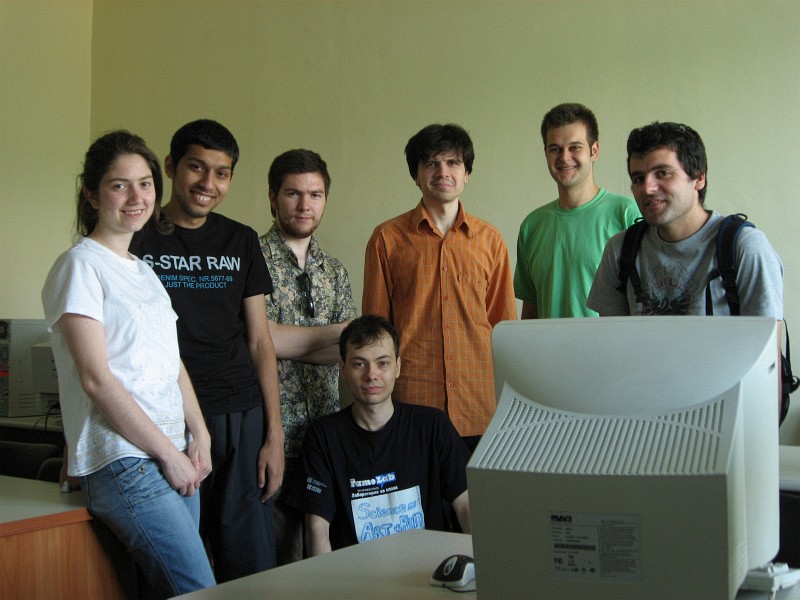
Some of my best students and me

About the Course at Plovdiv University, and the Course Program


I'd like to thank the vice dean of FMI Dr. M. Manev and FMI for accepting this unusual course, and my students for their curiosity, smart comments, agreements and disagreements. Your company was enriching and pushing me to share and think more. Now I'm not that alone in my dreams and interests about mind and intelligence.

I hope to keep discussing with you, feel free to comment in the blog, if you wish join the Facebook group and share materials or ideas you've found.

Another course is being conceived for the winter. If it happens, it would be even more advanced, focused on Boris Kazachenko's and mine most advanced concepts and what I manage to understand and invent up to then. The course may include brainstorms and discussions on solving real generalization, architectural, neuroscientific, implementation etc. problems. Hope to see you again there, eventually!

Trivia

- Ironically, the last class of the advanced and futuristic course was in the oldest lab at the University, the only one with CRT monitors left...  :)

- The caption in the balloon on the T-shirt says "Science = Art + Fun". I got the blank from a  Famelab competition. Closer view.

- If you're interested in tennis: yes, Plovdiv is the native city of Tsvetana Pironkova who defeated Venice Williams at the Wimbledon quarter-finals.  :)


Тагове: УИР, Универсален изкуствен разум, курс, университет, мислещи, машини, изкуствен интелект, трансхуманизъм, невронауки, ПУ, Пловдивски университет, студенти, колеги, 2010 г.,
Read More

Monday, June 21, 2010

// // Leave a Comment

Criticism on Novamente Cognitive Architecture, SOAR and Alikes | Критика към архитектурата Новаменте, SOAR... Курс по Универсален изкуствен разум

"Back to the Future" - an 80's classic movie and a favorite  

What's wrong with those cognitive architectures claiming to allow creation of Artificial General Intelligence (true Thinking mahichines)?

Какво не е наред в когнитивни архитектури Новаменте, СОАР и др., и защо създателите им са далеч от универсален изкуствен разум 
(истински мислещи машини, или "изкуствен интелект" както е старият лош термин, който повече им подхожда)


In brief, I've been disappointed from the papers on Ben Goertzel's Novamente  cognitive architecture (AGIRI's OpenCog seems similar), because they resemble too much SOAR-like cognitive architectures, rely on NLP, even Prolog-like "common-sense" logic.

Check out some:

http://www.novamente.net/file/AAAI04.pdf
http://goertzel.org/dynapsyc/2009/OpenCogPrime.pdf
http://goertzel.org/dynapsyc/2009/CognitiveSynergy.pdf

I have given up on a Bulgarian one, called DUAL, that uses micro-frames and a hybrid symbolic-connectionnist approach, having several levels of interaction of the entities - micro, macro... It was conceived in late 80-ies, inspired by Minsky's "Society of mind", multi-agent systems, frames, etc... It seems a bit general, but the micro-frames are to be filled manually... Also I don't see any meaningful results, achieved for 20+ years of *work*.

SOAR is "a star", it was created in late 80-ies as well, and while enhanced over time, again I haven't heard of any meaningful application of it (actually any at all), demonstrating AGI. Correct me if I'm wrong.


Architectures like this seem very elaborate at first sight, having fancy block-diagrams: they use to claim having declarative memory, episodic memory, intentional memory, attention, working memory - prides of Cognitive Science - proven experimentally to exist in human mind! They have knowledge-bases (Cyc-style are the best!), problem space, goal-states... I guess these kinds of "knowledge" are supposed to be filled *manually*, somehow like in the NLP semantic dictionary - WordNet.

I like very much the 80-ies style, I somewhat like 70-ies and 60-ies (also 50-ies),  but not really the AI-style.

Papers, journals, conferences on "Recent Advances in AI", PhDs...  And anything to impress anybody outside the conference rooms?... (Correct me if wrong)

Novamente is supposed to be better than SOAR, they claim to use probabilistic inference, trying to integrate smoothly different kinds of memory - in a really general AGI framework all those "kinds of memory" are supposed to emerge from something more general.  Novamente may work to some extent, but to me these high-level concepts, sticked together with "glue", don't look really smooth to evolve and learn well. 
 
However I partially understand guys who try to do something to seem meaningful and to sell it right now, an elaborated architecture with many blocks inside, socially acceptable and "scientifically proven" constructs might be taken more seriously than elegant abstract definitions. But:

A rule of thumb:  if an approach was feasible, for 20-some years of *work* it should had lead to a progress. To me so far it seems the same.
 
In the upcoming years, expecting:


Други ключови думи: Универсален изкуствен разум, Новаменте, когнитивни архитектури, СОАР, високо ниво, правила за извод, изкуствен интелект, Пловдив, ПУ, ФМИ, мислещи машини

Read More

Saturday, June 19, 2010

// // Leave a Comment

Comments on "Chaotic Logic" | Коментар към книгата на Бен Гьорцел "Хаотична логика" - към курса по Универсален изкуствен разум в ПУ

I've been checking out some of Ben Goertzel's works:


Read it at: http://www.goertzel.org/books/logic/contents.html

Chaotic Logic
Language, Thought and Reality
From the Perspective of Complex Systems Science

Ben Goertzel

Chairman and CTO Intelligenesis Corp.
Paper Version published by Plenum Press, 1994

What I liked:

- "Pattern and Prediction" (Ch. 2) 
- "The structure of thought" (Ch. 3) - multilevel control (hierarchical control)
- "Psychology and logic"  (Ch.4)
- Coverage of history of AI/logic/linguistics, good knowledge on particular philosophers, linguists etc.
- Different definitions of complexity

E.g. this lines on patterns: (Ch.2):

...Before getting formal, let us first take a quick intuitive tour through the main concepts to be discussed. The natural place to begin is with the concept of pattern. I define a pattern, very simply, as a representation as something simpler
(...)
In general, a pattern is a short-cut -- a way of getting some entity that is in some sense simpler than the entity itself. A little more formally, suppose the process y leads to the entity x. Then y is a pattern in x if the complexity of x exceeds the complexity of y....
, B. Goertzel, 1994
Also, "the amount of structure":

...These concepts may be used to measure the total amount of structure in an entity -- a quantity which I call the structural complexity. The definition of this quantity is somewhat technical, but it is not hard to describe the basic idea.

If all the patterns in an entity were totally unrelated to one another (as, perhaps, with this picture of the square next to the circle discussed above), then one could define the structural complexity of an entity as the sum of the complexities of all its patterns.

But the problem is, often all the patterns will not be totally unrelated to each other -- there can be "overlap." Basically, in order to compute the structural complexity of an entity, one begins by lining up all the patterns in the entity: pattern one, pattern two, pattern three, and so on.

Then one starts with the complexity of one of the patterns in the entity, adds on the complexity of whatever part of the second pattern was not already part of the first pattern, then adds on the complexity of whatever part of the third pattern was not already part of the first or second patterns, and so on.... B. Goertzel, 1994...

I think it's in the right direction of compression and prediction.

A discussion on Nietzsche and logic at Ch. 4  :

Nietzsche declared consciousness irrelevant and free will illusory. He proposed that hidden
structures and processes control virtually everything we feel and do. Although this is a commonplace observation now, at the time it was a radical hypothesis. 
Nietszche made the first sustained effort to determine the nature of what we now call "the unconscious mind." The unconscious, he suggested, is made up of nothing more or less than "morphology and the will to power." The study of human feelings and behavior is, in Nietszche's view, the study of the various forms of the will to power.
(...)
... Note how different this is from Mill's shallow psychologism. In the Introduction I quoted Mill's "derivation" of the Law of Excluded Middle (which is equivalent to the law of contradiction, by an application of deMorgan's identities).  Mill sought to justify this and other rules of logic by appeal to psychological principles. 

In Mill's view, the truth of "A or not-A" follows from the fact that each idea has a "negative idea," and whenever an idea is not present, its negative is. This is a very weak argument. One could make a stronger psychological argument for the falsity of "A and not-A" -- namely, one could argue that the mind cannot simultaneously entertain two contradictory ideas.

But Nietzsche's point is that even this more plausible argument is false. As we all know from personal experience, the human mind can entertain two contradictory ideas at once. We may try to avoid this state of mind, but it has a habit of coming up over and over again: "I love her/ I don't love her", "I want to study for this test/ I want to listen to the radio instead".

The rule of non-contradiction is not, as Mill would have it, correct because it reflects the laws of mental process -- it is, rather, something cleverly conceived by human minds, in order to provide for more effective functioning in certain circumstances.

 ...One rather simplistic and stilted way of phrasing Nietszche's view of the world is as follows: intelligence is impossible without a priori assumptions and rough approximation algorithms, so each intelligent system (each culture, each species) settles on those assumptions and approximations that appear serve its goals best, and accepts them as "true" for the sake of getting on with life. Logic is simply one of these approximations, based on the false assumption of equality of different entities, and many auxiliary assumptions as well....  B. Goertzel, 1994


Disliked:

What I generally didn't like is too high a level speaking, too much typical syntax-semantics-symbols Linguistics, Psychology, NLP and philosophy; couldn't see "good physics" thus couldn't really sustain reading all in details.

I suggest : What's wrong with NLP... series: http://artificial-mind.blogspot.com/search?q=What%27s+wrong+with+NLP

A curious fact is that a Bulgarian humanoid robot project Kibertron mentions "Chaotic logic computer" in their brief explanation of their "theory of natural intellect", don't know is it related to the book. Unfortunately the company claims they need 5 million Euro to make this "natural intellect" working, together with the robot.

A general advice on reading 

Use your time wise, don't read thoroughly too much. Try to understand when reading more in a topic would be worthless. A very little essence would last in your mind and would make real sense, the rest and most might be just time passed without memories and without work done.

The talk on "saturation of learning" will be continued.
Read More

Saturday, May 22, 2010

// // Leave a Comment

Юрген Шмидхубер - красотата, любопитството, машината на Гьодел. Курс по Универсален изкуствен разум, Други учени и насоки за изследванe.(Част 2 от ..)

Юрген Шмидхубер е един от водещите учени в УИР, твърди че неговата амбиция е да създаде съвършения учен - машината на Гьодел, която решава всякакви задачи. Занимава се с рекурентни невронни мрежи, т.нар. LSTM - Long Short Term Memory, които имат някои от възможностите на HTM като предсказване и йерархичност. Пише за универсални алгоритми за самообучение; за красотата и изкуството и връзката им с принципите на универсалния разум, подобно на това което си говорихме в седмата седмица, но в математически издържана форма. Може би ще поговорим още малко за красотата, интересността и любопиството в осмата (на 28-ми май).

В сайта на Ю. Шмидхубер: http://www.idsia.ch/~juergen/ може да откриете много материал за четене, препоръчвам ви да гледате презентацията му на Singularity Summit 2009. Освен интересна, е много забавна и смешна.  :)
Алгоритмични принцип на любопитството, интересността и красотата (на английски)

Jürgen Schmidhuber at Singularity Summit 2009 - Compression Progress: The Algorithmic Principle Behind Curiosity and Creativity from Singularity Institute on Vimeo.


Keywords: Jurgen, Juergen, Schmidhuber, Creativity, Beauty, AGI, UAI,
Read More

Thursday, April 8, 2010

// // 6 comments

Universal Artificial Intelligence (Artificial General Intelligence/AGI) - Course Program, Plovdiv University | Универсален Изкуствен Разум - Програма

by Todor Arnaudov (aka Tosh, The Twenkid)


Age: 25. M.S. Software Engineering 2008 (Second? average grade in alumni), B.S. Computer Science 2007 (Best average grade in the alumni) at Plovdiv University. 

Intern at RIILP Wolverhampton – Computational Linguistics/Natural Language Processing. A polymath, independent researcher and versatile artist, working on establishment of a private company for R&D in Artificial General Intelligence and other fields, as well as a professional film and multimedia studio.

Info from Plovdiv Univeristy: 
http://fmi-plovdiv.org/index.jsp?id=1060&ln=1

More Info:                  Български  
An interview in a popular-science magazine: http://research.twenkid.com

Twenkid Research: http://research.twenkid.com

Lecture Slides and other materials:
 https://research.twenkid.com/agi/2010/  

Todor Arnaudov's Researches Blog: http://artificial-mind.blogspot.comTwenkid Studio 

(mostly in Bulgarian yet): http://twenkid.com

Video (English):
 
http://artificial-mind.blogspot.com/2019/07/agi-course-plovdiv-2010-screencast.html

Видео с една от първите лекции в курса с нови коментари: "Какво  е Универсален изкуствен разум?": https://youtu.be/r582MVKj81A

Universal Artificial Intelligence(Artificial General Intelligence/AGI)


Program as of April 8-th 2010 (a syllabus)


It will be taught in Faculty of Mathematics and Informatics of Plovdiv University, Bulgaria, starting from 9-th of April.

The course is appropriate for undergraduate students who want to work in the very advanced interdisciplinary field of the Artificial General Intelligence/Universal Artificial Intelligence, also known as Strong AI. It would be interesting also for those who just want to learn what are the current theories of intelligence and how the brains and mind work, according to current theories and speculations. The course tries to give the direction of how to design a thinking machine, eventually self-improving, and gives the directions for deeper study and research.

This course is original and it seems it's one of the first worldwide, if not the first* as systematic and interdisciplinary one, including:

- Futurology (Singularity, Transhumanism)
- Neuroscience  - How Brain works
- Developmental Psychology
- Behaviorism/Reinforcement learning in living beings/humans and machines

Even Love as a form of reinforcement learning “bug”. ;) The course gives insights and theories of intelligence/Universe and meta evolution – higher level principles that cause and drive Universe evolution - which seem not to be popular yet – Boris Kazachenko's and mine. 


I will give students also some ideas of how and why to do practical research and engineering and high-tech entrepreneurship, something I'm trying to start-up myself and have some experience as an engineer (employee) in a fabless semiconductor start-up. The course is appropriate for all undergraduate students, because the special preliminary knowledge is taught in the course. A graduate student barely have an  advantage over a second year student.

Lectures will be in Bulgarian, but knowledge of English is highly recommended, especially if you wish to deepen your knowledge in the field. The exam will be a test.


Probably; eventually I will translate the course to English. Maybe teaching it abroad if I manage to reach to that point.


Universal Artificial Intelligence

  1. Introduction to the course. Why should one do research, especially so brave? PhD – Pro & Con. Is it possible to do a private research/science and scientific business? What is a Start-up? True stories and advices.

  2. What is Artificial Intelligence? Is it possible? Criticism and scepticists – Searle's Chinese room. Summary of the classical AI and why it failed. Review of the results and successes in current Weak AI (specialized/narrow AI) – why do they have limitations. Cognitive Science and cognitive architectures.

  3. What is Universal Artificial Intelligence (UAI, AGI, Strong AI). Technological Singularity and Singularity Institute. Transhumanism. Expected computing power of human brains. Attempts for literal simulation of brains. Universality paradox of the brains. Ethical issues, related to AGI.

  4. Complexity and Theory of Information. Probability Theory – statistical (empirical) probability. Chaos Theory. Systems Theory. Emergent functions and behavior. Universe as a computer – digital physics. Algorithmic Probability. Kolmogorov's Complexity and Minimum Message Length. Occam's Razor.

  5. Design of Mammalian and Human brains.

  6. What drives mammals and humans? Behaviorism – Reinforcement Learning as a Universal learning method. Supervised learning and imitation.

  7. Developmental Psychology (Child Psychology). Stages in cognitive development. First language acquisition.

  8. Machine Learning. Markov's Chains. Hidden Markov Models (HMM). Bayes Networks. Hierarchical Bayes' Networks and Hierarchical HMM. Principles of the algorithms of Viterbi and Baum-Welch (Expectation-Maximization).

  9. Tests for human and machine intelligence. Definition of a reinforcement learning Intelligent agent, according to Marcus Hutter. Beauty according to Jurgen Schmidhuber and Todor Arnaudov. Schmidhuber's Godel Machine.

  10. Theory of Mind and Universe by Todor Arnaudov – mind as a hierarchical system of interacting universal simulators of virtual universes. Universe as a computer and trends in Universe evolution. 

  11. Theory of Intelligence by Jeff Hawkins. How the neocortex in mammals and human works. Memory-Prediction Framework and Hierarchical Temporal Memory.

  12. Theory of Intelligence and Universe Meta-evolution by Boris Kazachenko. Cognition: hierarchically selective pattern recognition & projection. Мeta-evolution as Abstraction of a conserved core from its environment, via mediation of impacts & responses by increasingly differentiated adaptive interface hierarchy. Boris' prize for ideas.

  13. Summary of the principles of intelligence according to Todor Arnaudov, Marcus Hutter, Jeff Hawkins, Boris Kazachenko and others. Prediction, hierarchy, bottom-up development, scalability, complexity growth. Seed AI. Sample architecture of an AGI/UAI agent.

  14. Ben Goertzel's cognitive architecture Novamente.

  15. Other researchers and private companies in the field of AGI. Bibliography, references, links and directions. Discussion and Questions.

  16. Exam.

    See you in class! ;)

    * I know about the summer school of Ben Goertzel, Hugo De Garis and their colleagues in Xiamen 2009, but according to their program, it lacks significant parts, e.g. Jeff Hawkins is not even mentioned. http://www.goertzel.org/AGI_Summer_School_2009.htm
    Read More