THE SACRED COMPUTER - СВЕЩЕНИЯТ СМЕТАЧ, a.k.a. ARTIFICIAL MIND: Thinking Machines, Creativity and Human Development. A pioneering virtual Research Institute for Artificial General Intelligence (AGI), Cosmism and Transhumanism, AI, Software, Interdisciplinary General Research, Creativity, Versatility, Universal Men ~ Twenkids etc. Created in 2000. (...)
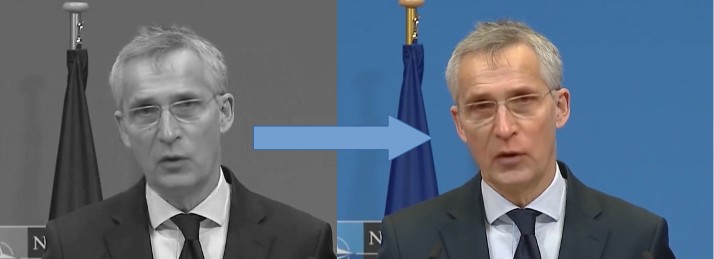
I had the colorization in mind before I started the refactoring of Deepfacelab to include grayscale models, and lately I added this functionality, for now as a POC, to be published later. The colorization is done with a Pix2Pix model (based on the example on Colab with the facades, maps etc.), trained on the faceset of the color video - grayscale faces converted to color. There is a step of color stabilization, which was required for more pleasant output, because without that there was slight, but noticeable flickering. The experiments for now were only on a single video/segment (about 1000 frames training of the pix2pix model) and without pretraining on other/various faces - that is something to be done in the future.
I am still pushing the limit of a GF 750 Ti 2 GB - so now it can produce 192x192 color lip-synced deepfakes with reasonable quality. The SAEHDBW DF-UDT model is about 345 MB initially (a bit more when trained), the Pix2Pix model is about 131 MB.
Note that the pix2pix model did fit in GPU only 128x128, but a sharpening at the end of the pipeline improves the image even more than the original grayscale one. Training at 256x256 on the CPU is a possible option, too, because the pix2pix model seems to be fast and also possibly the applied color stabilization can repair some fluctuations, i.e. possibly it can be not perfectly trained and still capable to produce decent results - that is to be verified with other videos. I haven't tried to colorize the Arnold's model yet.
The glasses of Stoltenberg are in most cases reasonably depicted, except a few little glitches from the grayscale model.
After investigation of the properties of the colorized faces, debugging of the merging, there was a successful application of an idea for stabilization of the colorized output and merging with precomputed faces (for other usages as well, e.g. prerendered 3D-models or synchronously performing faces etc.). In the video example below the output is also sharpened after merging (whole frame) - it needs to be per face only etc. or to have some antialiasing eventually.
The color-gamma stabilization is done by first probe-rendering all faces, computing their total pixel weight per frame and the average of all frames, then adjusting the gamma for each frame according to the average in order to flatten the fluctuations: if the face is too dark - it gets lighter and vice versa. Indeed, this phenomenon itself is to show some intrinsic properties of the pix2pix model.
Finally there is sharpening and merging is performed using these corrected faces.
...
* The neural model didn't capture the blue tint of the model's eyes, but it had a little excuse - the color of the eyes in the video varies and even there are frames where the ground truth eyes are different colors: one is very gray-blueish-purple and the other one - brown.
Another demo of the capabilities of my new modification of DFL2.0 - this is trained just on a Geforce 750 Ti. See the previous post and github: https://github.com/Twenkid/DeepFaceLab-SAEHDBW
Regarding the modification of the library to work with grayscale images instead of color ones, that I did in order to create the film with theoretically 3 times higher performance and/or details with the same hardware - see info in future posts.
Български
Встъпително обръщение на Арнолд Шварценегер - Губернаторът на България в интервюта в Народното събрание, пресконференции в министерския съвет и БТА, Би Ти Ви, Дневник и др. Какви са целите на Терминатора на България? Кого иска да представлява? Какви са идеалите на Партията и пр. Арнолд е избран от народа, за да донесе политическа стабилност в най-стария щат на Балканите и да приведе Зелената сделка в действие - така както го направи в родния си щат Калифорния по време на двата му предишни мандата.
Автор: Тодор Арнаудов - Тош/Twenkid
Следва продължение
English
The inspiring inauguration Speech of the new Governor of Bulgaria: Arnold Schwarzenegger from his interviews in the Parliament, the council of ministers, for bTV, Press conferences in BTA, Dnevnik etc. What are his goals, who he wants to represent, what are the ideals of his party etc. Created by Todor Arnaudov - "Twenkid". Arnold will be back!
Idea, production design, story and script, programming, dataset collection, training, retouch, editing, music directing, timing, sync etc.: Todor
Deepfake software developers:
1) DeepFaceLab 2.0 by iperov et al.
2) DeepFaceLab-SAEHDBW by twenkid - the grayscale model and mode for the movie, allowing me to train a 3 times bigger model on the same GPU.
Видео с обяснение на ефекта от клипа "Сън в летен дъжд" (2019).
* Цел на ефекта: видео с голямо увеличение, заснето с нестабилна камера от ръка, с шумна картина в пороен дъжд, при което се виждат отделните капки. По хитър прост начин автоматично да се заличи нежелано лого на верига магазини (постоянно пресичано от капките дъжд), като ефектът да не изглежда неестествено и се запазят дъждовните капки.
-- Използван в епизода "Сън в летен дъжд" от поредицата "Дивия Пловдив".
Coded: 28.11.2019 - 29.11.2019 in Plovdiv, Bulgaria (и малко промени около 16-17.9)
Трябваше да стане по-хитър начин и задоволително добре, не беше нужно да е съвършено, защото беше само един кадър от 3 секунди и не можеше да се занимавам прекалено дълго само с него. В същото време исках да използвам кадъра, защото имах нужда да разнообразя монтажа и защото картината, освен нежеланото лого, беше живописна и интересна.
Програмирах го на "Python" с OpenCV, като OpenCV служи само като видео интерфейс, обработката е "ръчна" - пиксел по пиксел.
Ако не валеше дъжд и камерата беше стабилна, можеше да се нарисува с "GIMP" или Photoshop веднъж и да се размножи в кадрите, но тогава сцената нямаше да е толкова интересно. С постоянно променяща се позиция и капки дъжд, беше непосилно да се нарисува 83 пъти, затова трябваше да се програмира.
...
Бел: Да, маскираното лого можеше да бъде по-светло (като ламарината на магазина), но така пък изглежда като продължение на металния стълб. По-светло - в следваща версия.
Python, OpenCV
PURPOSE: Automatically remove a logo in shaky, rainy, noisy video and preserve the raindrops crossing the logo
https://youtu.be/OWI7HQWyZWg
An Unreal Star Storm watched from the forests of the Rhodope Mountains, Bulgaria
The premiere of my new music video - a poetic and artistic production with beautiful 2D visual effects, produced using computer vision for automatic compositing, masks generation, objects removal etc. Edited and rendered using my inhouse software "Twenkid FX Studio".
Watch in darkness and on a big screen in 1920x1080!
"Twenkid FX Studio" is an endless "prototype" in which I've invested too little time and had to redesign a long time ago. Using Win32 sounds a bit insane, but my choice when I started was because there were issues with the usage of another "default" and having bad reputation simple windows library (MFC) - I used Visual Studio Express.
Sure, there were free GUI class-libraries, but I preferred a smaller code base that was not dependent on additional huge third-party libraries* such as wxWidgets (which was considered and maybe I was wrong not to develop with it).
Qt had some issues with the license - I didn't want my system to be GPL, and their other license fee was unreasonable. Maybe I could try GTK, but it's also bloated with a lot of dependencies and verbose method calls, similarly to wxWidgets, so apart from being multiplatform, I don't know would it be "simpler" to work with than Win32 or my own Win32 wrapper.
Furthermore, at the time when I started, FFmpeg or other Linux video libraries seemed undocumented/unaccessible, while I found a windows' one, although a bit outdated - VFW (Video for Windows). DirectShow was the more appropriate choice, but it seemed to me that it had more complex interface and harder access to the raw bitmap, so I decided to use VFW and not delve too much. Maybe I was wrong here again, I had to spend some more time on DirectShow.
(*Regarding huge code bases with too many fragmented modules - respectively I don't like Boost with its 999999 tiny little files, most of which not used.)
So I started with simple Win32, I developed also simple wrapper classes for some controls. I didn't care that it didn't look "beautiful" or "modern", the buttons look-and-feel was not important.
One reasonable design choice was to develop the GUI in C# with an interface to the core processing through pipes, sockets or memory mapping (file-mapping in Windows), it's still an option. It would go with a "standardized" interface to the core editor so that it could be controlled from all kinds of external GUIs. I did something like that with my speech synthesizer "Toshko 2.070", but only for simple input, not full API to its internals.
Another possibility is Lua and/or automatic generation of the GUI from the specifications.
...
Historically, there were years with zero or a few lines of code added to the project and unfortunately the editor's GUI is still underdeveloped and ugly for casual users which prevents it to be released for external usage out of my "in-house" needs.
It's pretty fast for some tasks, though. For example, Twenkid FX loads the long version of the "Star Symphony", including alternative disabled video segments and overlays, 200 full HD video files in total, for the first time in a fresh session in about6-7 seconds1.5-2 seconds from a laptop's mechanical HDD and external HDD. Maybe that's the total seek-time for so many files.
If the project is then closed and re-opened again, it loads and is ready in just 2 seconds.
(It seems that test run was with a highly loaded RAM and page-file slowing it down).
The GUI has to be improved, though, and possibly rewritten in a multiplatform way to escape that Windows dependency. I've been thinking about that from time to time, but it requires enough of focus to start.
Perhaps it would be based on FFmpeg, OpenCV and OpenGL, maybe using multiple programming languages (Python and C++, maybe others) with a custom GUI written on top of OpenGL and OpenCV or some light GUI or gaming library, unless I changed my mind and continued with Windows and a DirectX11-12
Also it's supposed to start utilizing some form of AI already, of course. Finally...
...
Custom VFX system and effects for the movie:
* Python,OpenCV with Python, Numpy; a little C++ and OpenCV in C++ for some retouch work of already rendered video segments during the final stage of the editing.
I started with Python because I had a prototype for simple reviewing and cutting, besides my main GUI NLE editor. Of course I was assuming that it would be easier to experiment with OpenCV, even though I knew it'd be slower, and initially I didn't know how far I'd go with the visual effects.
I could use C++ without a big hurdle, since I had experience and experiments with OpenCV C++ as well such as applying computer vision processing over pictures and frames of videos, traversing pixels and changing them during playback etc. The heavier editing system Twenkid FX C++/Direct3D9 was also an option, especially as HLSL shader, the only simple way to add new effects. However it needs a general and sophisticated plug-in subsystem, which is still lacking.
So I took the Python road this time.
It got too slow for some operations, then some tricks with Numpy fancy indexing sped it up, for one of the early effects: 60 times, from about 30 seconds per frame to about 0.5 seconds per frame. However it still remained slow for complex effects, sometimes taking several seconds per frame.
Ironically, the slow speed sometimes was "right", allowing real-time adjustments during rendering, virtual camera operating for Pan & Scan sequences etc., without slowing down the playback or stepping manually frame-by-frame.
Of course, I had better worked with C++ and GLSL or/and HLSL shaders from the start.
CogAlg Prize
Nevertheless that performance-wise wrong design decision and involvement with Python and Numpy directed me to check the CogAlg* project, then eventually to contribute to the debugging of the stuck frame_dblobs function and to win a prize.
Python is a bad choice for a "non-neuromorphic deep learning" for computer vision at the low level of the system, which is expected to require a zillion of operations before starting to produce meaningful output, though. Besides CogAlg's code is getting progressively unreadable.
This is another story, though.
* B.K. is the creator of "Cognitive Algorithm" project, but I recalled that I first called it with that shorthand "CogAlg" in an e-mail a few years ago, and he adopted it.
That's my new short-film, where I'm a writer, director, actor, "make-up artist", "production designer", music composer and performer*, editor, animator, developer of the software for editing, ... and whatever.
Contra (the name may adjust) is my new nickname, it's also an introduction of my new channel "Hackerboy", I plan to create something like a "video log" regarding hacker's and hackerspace experience, however I guess it will be an "artistic one".
CINEMATIC PREMIERE
There was a pre-premiere during Hackafe's New Year's party on 22.12.2016 in front of about 35-40 people. The audience laughed. :)
It's a 3-minute low (no) budget movie, one-man show, but if you like video games, particular classic shooter, costume play (cosplay) and my acting, it's fun.
I'm looking for partners to join me - I want to create more sophisticated sequels, that's an introduction.
To be continued...
* Most of the music is inspired or interpreting/variating motives from the music from the NES version of "Contra", there's also a simple "original" progression in the beginning.
These are a few shots from the "after-shot" of a short action-fantasy-fan-CosPlay movie at Hackafe - the Plovdiv's hackerspace and co-working space.
I participated with that outfit at Plovdiv's "Night of the museums and the galleries" on 24-th of September - where I welcomed the visitors. I was without the make-up, though. ;)
Following - more pictures and the movie itself, when I manage to edit and post-process it...
I proposed to organize a Cosplay event at Hackafe, but it's still an idea.
...
Thanks to Rangel, "Hackafe", Konami and to my ... inspiration. ;)
... Keywords: soldier, warrior's orders, uniform, Contra, Super Contra, Contra Hardcorpse, Cosplay Party, 8-bit, console, Nintendo, NES, 8-bit video games, emulators, arcade machine, controller, joypad, Plovdiv, Bulgaria, Bulgarian cosplay actors, Tosh, Twenkid,Twenkid Studio, Тодор Арнаудов
Comment by Todor Arnaudov, inspired by/on: http://www.hudsandguis.com/home/2011/01/02/terminator-the-evolution-of-machine-vision
I'm a fan of the Terminator and liked the article, but I'd challenge the statement in the introduction that the displays in the movie are:
"how the robots would potentially see the world"
I think it's rather how HUMANS imagine that they themselves would see the world with added "computerese", " coders' ", " programmers' " decorations on the screen/view, like pilot's screen, computer simulations screen etc.
It's a style to show "computer stuff" to no-computer literate/experts, especially in T1 and T2.*
We are limited with one "screen", the final one, the integration of the two retinas, but machines are not.
In my opinion a more adequate representation would be a huge set of images (screens), virtually unlimited, displayinga gradual coverage of different kinds and depths of image processing, analysis and understanding. The will-part (what you want, search for, find) is in additional layers.
It cannot be perceived in-full in real time by a human, but in a future kind of interactive or multi-screen/explorative/educational/deep films it could be explored, in a space like the following:
1. Raw input, normal vision
2. Set of simple image processings (contrast, gamma, posterize/levels, ...) - different slices of the visual spectrum. The reddish view is one of it.
3. More complex - lines, blobs, contours, ...
4. Sets of templates for matching when searching. That's like the content of the executive function's top-down attention, consciousness. The templates on their own could cover a lot of screens with different representations - visual in full-colors and lighting, wireframe, gradient depth-views, different conditions, 3D-coordinates, different angles for complex and assymetric objects, similarities with others, taxonomies/classes etc., animated/rotating, zoom-in-out, different sizes.
5. 3D-reconstructed scenes, different views, distances to/between objects, sizes ... Dimensionally-reduced 2D views of the reconstructed 3D scene like in a 3D-editors: XY, XZ, YZ.
6. Connections between images - graphs, networks, sequences of flashing of different images; displaying the path of thought, search etc.
7. Paths, trajectories - past, taken, projected, predicted (correctly, wrongly); own-paths, trajectories of intended motions and transformations in the environment, sequences of planned actions, ...
8. Graphs (networks), trees, block-diagrams; blinking, different colors, different-shapes - expressing different concepts, relations, distances (ranges of distances) etc.
9. Etc.
10. The machine could see the numeric views/intentions as code, captions, indication of the will with specific symbols (instead of images), textual descriptions etc. without vision/screen, without all these text "blots" on the video that we, humans, need with our limited sensory input and processing capabilities.
For the machine they are at different layers, it could perceive all or switch attention between selected ones. There could b
However, similarly we humans do also see a lot of "numbers" without "dirtying" and overloading the "screen". We do "feel" them and express that in our actions, such as we display that we know the precise spatial coordinates of the objects and our hands by applying correct motions for grasping the objects, kicking a ball; when playing a musical instrument, improvising by ear, and applying the right sequence of motions with the right speed etc. We do "see" the numbers, but "intuitively", without a need to read them as high-level abstract symbols and translate them into motion vectors.
Etc. -- go on and synthesize more continuations and unfolds of the ideas and directions given above.
* See a follow-up article on touch-screen GUI incovenience
PS1. I'd like to note also that the code in T1 is 6502 assembly listings (Apple II, NES, ...). There's a caption about 16K memory bank switching, so it's maybe does bank-switching and had more than 64 KB RAM... :)
PS2. Regarding the choice of the sayings with the hilarious "FUC* you, as*hole" line - the author is right that it could be more dynamic, for example by displaying initial *search process*, exploration of possibilities and with a more dynamic graphics (it could be done in a remake of similar conditions, maybe).
The limited amount of options could be the final choices, the most appropriate for the situation and what the Terminator wanted.
The search is already done "subconsiously" and that's what the executive functions are provided with, in order to select an option from - the executive functions of human viewers, too.
Human persons with similar "profile" - e.g. "contract killers" or cowboys or typical "criminals" in the millenia of gangster movies - would also have a limited set of expressions for similar conditions.
And in general if you asked a multitude of people with similar personalities, experience, capabilities, knowledge etc. for the most appropriate answers in this-or-that situation, you'll get the same answers and the same lack of imagination (especially if they are asked to give *the most appropriate* ones in order to achieve certain goal, or to send a specific message).
The Terminator didn't want to engage in a conversation, he didn't want to open the door and be seen etc., so to me the lines are adequate.
PS3. I agree about the coolness of the OCR in T1, the scene where the Terminator reads the hand-written phone number. The scene with his fingers pointing the numbers in the phone-boot is silly, though; unless that's a deliberate non-functional design; just posing, intended to make the machine look more human for the potential humans around - and for the viewers of the movie, too. (From cinematographer's/director's point of view, obviously that's literaly for "pointing" the attention of the cyborg.)
PS4. This discussion is too verbose? I like/intend to give precise explanation of why I think so and so, what made me think so etc. That's the path of thought. And indeed, a comment on another article - see a follow-up article on Spaghetti code.
A commentary on a critique about Kurzweil's latest book:
http://www.newyorker.com/online/blogs/books/2012/11/ray-kurzweils-dubious-new-theory-of-mind.html
"...Kurzweil doesn’t know neuroscience as well as he knows artificial intelligence, and doesn’t understand psychology as well as either. (And for that matter he doesn’t know contemporary A.I. as well as the A.I. of his heyday, when he was running his companies thirty years ago.)
To truly reverse-engineer the human mind, we may need a real consilience, to borrow a word from the Harvard biologist E. O. Wilson, a coming together of workers in A.I. with researchers who study the human mind from a wide range of perspectives—neuroscientists and cognitive psychologists, and maybe even artists, musicians, and writers, too. The challenge of figuring out how the mind works is too complicated for even the smartest of entrepreneurs to solve on their own.
Gary Marcus, a professor of psychology at N.Y.U., is the author of “Guitar Zero: The Science of Becoming Musical at Any Age” and “Kluge: The Haphazard Evolution of the Human Mind.” ..."
Here I am... I am also "even an artist, musician, writer..." (and a bunch of all kinds of others) + the researcher and technical part, but apparently until I get rich/climb the social rank system or implement practical systems, that has no value in the world occupied by evaluators who are multi-domain and cross-domain blind. Until that time - nobody even notices that you existed.
And the mass audience - it doesn't even realize, that it doesn't applaud most the smartest genii of its time, but the ones which are promoted by the strongest media of the time, especially since it is not qualified enough to judge the work in its technical aspects. (See "Issues with like/dislike voting (...)" in a recent publication, and also an upcoming one.)
The domain blindness is one of many concepts from an upcoming new major treatise (I'll keep the title secret for now), which I've started as an answer to the paper on Musical Beauty and Compression, but it naturally grew in all directions and the methods that I apply need a big enough exposition and integration. It's already many times longer than a conference paper, it might be also a multimedia work, maybe even demos of basic implementations of algorithms, not just a paper. There's also a discussion regarding social biases and confusions about intelligence. "And a lot of stuff."
It would be a sort of "Twenkid's Theory of Mind and Universe" or something, a continuation of my classical period works, the "Teenage Theory of Mind and Universe".
Unfortunately I don't have a lot of time slots lately for the paper, been involved with other task. If I find a time-slot, I will also share some notes on the matches from the works from my "Teenage Theory of Mind and Universe" to Hawkins' "On Intelligence".
I thought about sharing a short story about what it's like to do diverse polymath stuff, who may attention explores enormous amount of topics in a short time, maybe next time.
***
By the way, I had some fun lately producing a new comedy short (micro) film lately, but I've still not published it for free viewing - only in "selected theaters" with excellent reviews from the viewers.
Just to illustrate what a "domain blind" research of intelligence cannot sense, while a "seeing" one senses and understands.
Even in that tiny little movie I've been:
- Writer (it's a tribute, most of the script is borrowed/adapted/selected, but it also has to be selected and adjusted in order to be coherent etc.)
- Director
- Director of Photography and Camera Operator (framing, light selection - as long as the spartan conditions and equipment allowed, you'll see in the movie)
- Author and Performer of the Original Music (it's simple, it probably matches some "standard" one, but it's not intended/I am not aware of, it was improvised on the keyboard) - keyboard, and electric guitar and bass (from a 2012 rock piece of mine)
- Actor in ~6 roles, in non-native language, with 2 different accents and voice-alterations (most are very short, due to the length of the film)
- Juggler (5 beanbags, very low and quick throws)
- Video Editor/Compositor
- Sound Recordist and Editor
- Sound Effects Maker (including with my mouth :) )
- Wardrobe and Property Master
- "Production Designer"
- Author of the Original Video Editing Software - I've designed and developed it myself (you know about it - it requires from me to develop some crucial tools for cinematic magic, and this film again reminded me that I should find time for it).
I may have missed something.
IMHO that's one example of "general intelligence", in combination with other artistic and scientific and technical domains where I am proficient - a versatile, universal intelligence, it includes and implies versatile capabilities to learn and understand and master virtually any possible target domain.
The above is related to another discussion from the upcoming treatise, a new iteration over what general intelligence is and about nuances regarding "human level intelligence" and its testing. I make a distinction between truly general intelligence and another type which is often confused and is a subset, lexically close and a part of GI, but much narrower.
Finally, enjoy the latest exhibition of graphical portraits by my father Iliya, he's a really talented artist:
"Give it to me!", or "Love's no Friend of Mine" - hard rock & punk musical, with music by Todor "Tosh/Twenkid" Arnaudov(*see below) and the great Bulgarian punk band "Kontrol". Starring Tosh and Anya Chuleva, directed by Tosh. *Played, arranged and partially created - parts from a jam session starting from Rainbow's "Love's no Friend" theme, transitions and progressions on guitar, bass and keyboard; rhythm fillings; a "Van Halen"'s cover, Kontrol's song improvised cover solo, some Offsrping's riffs, and film music arrangement of a transition between themes. Edited and composited with Twenkid FX Studio (prototype).
Part of cutting and most important - the special editing effects: picture in picture and post-production re-framing/cropping (you may not notice it), as well as the animated and static titles are rendered using my custom software Twenkid FX. They couldn't be done without it.
- I won the first Boris Kazachenko's prize in AGI! Knol
- The time for the new version theory of mind has come. Recently I've been translating in English my Teenage Theory of Mind and Universe" (2001-2004). The new "Twenkid Theory of Mind and Universe" is trying to turn philosophy and ideas into a formal implementable theory and eventually prototypes.
Video Editing/NLE (non-linear editing)/Visual Effects
This project - Twenkid FX - was frozen for 2 months, lately I'm trying to spend a little time on it again - I need the software for my movies. It's still limited, but now has some really practical features such as doing complete NLE editing (cut) and using its interface to generate scripted jobs for VirtualDub, turning it into a non-linear editor.
It's too early to share it for other users, though. Stay tuned for news.
Acting and Filmmaking - Stoichko Hristov and Johny Johnson
This is the first teaser trailer of my short film "The Gift" (A Dream), includes moment from "the making" of it. What I'm saying means: I was late... When I just arrived up here, the sunset was still visible and there was a beautiful red light. A moment later - everything went dark... Genre: Experimental, Symbolic, Fantasy, "Dressed Erotics", Erotics, Thriller, Drama, Animation, Modern Dance
It's an ultimate author film, inspired by my own love poetry, characters inspired by a two-part novel of mine, called "Ada" and "Raya". Music is composed and performed also by me in mid-2009, it was a test one. Shots in this teaser are done in late 2008 and very early 2009, but are shown as late as February 2010. Work on the movie was frozen, there are some complex scenes to be shot and/or composited with some CGI.
Twenkid FX
The other important character in the film, a beatuful woman, is not visible here. Her and the movie as a whole require some visual effects, and I'm working on a custom Video Editing/Compositing/Visual Effects software, it's called Twenkid FX. "The Gift" will not look like "Transformers", the effects will not be zillions of polygons etc. - simple, but beautiful and artistic, combined with appropriate artistic shots.
The software is in an early stage of development yet, I'm designing it. For now it provides basic compositing.
Effects done on frames from "The Wedding" (short film)
Some planned/desired features sounds like:
- Complex matte painting with static and animated masks - Manual, semi-automatic and intelligent motion tracking and motion compensation - Particle effects system - Ligh/Lightning/Space rendering effects - Intelligent color correction/color matching Maybe also some forms of motion capture, related to motion tracking/compensation, they all may assist rotoscoping - turning video to animation/masks.
An experiment from 2005. A combination of two videos with masks for the intersections.
The video editor/NLE/computer graphics environment I'm developing has no name yet and is getting its basic capabilities yet - opening video file, rendering 3D-graphics, postprocessing video, outputting to file. It's supposed to serve at least for the visual special effects needed for my fantasy short film "The Gift".
I've been waking up my old-old passion for computer graphics, started as early as 90-ies. :) Smooth bit-mapped animation at 35+ fps, wire-frame 3D and a bit of texture-mapping on an 1.018 MHz Apple][ clone Pravetz-8M... There was even an animatronic/animation science-fiction movie partially done, with some music and test audio recordings. :)
...
Работя по свой видеоредактор/среда за компютърна графика/визуални ефекти. Все още в съвсем ранна фаза. Би трябвало да послужи за специалните ефекти на "Подарък".
"Trigonometric-3D" - I would call it "ellipse perspective transformation", my own invention from 1999 on a Pravetz-8M (Apple II clone).
Language in video is French and Bulgarian. There are subtitles in English and Bulgarian. (Closed Captions - CC) It works fine with Firefox, not sure for other browsers.
Run the video and click on the Arrow down right to select. Пуснтете видеото и щракнете на стрелката долу вдясно за да изберете български субтитри. Enjoy!
http://www.youtube.com/watch?v=NNiktFbzXK4
Film: I love Genre: Multilingual comedy. Lenght: Short or "short feature". Synopsis: Foreigners explain what they like and dislike about Bulgaria in a multilingual story. Featuring: A Frenchman (and two Frenchwomen), Italian, German, Japanese (starring Todor Arnaudov), an American and maybe others. Status: Plot, partial screenplay, characters, tests - see below Louis.
Trailer of one of my new short films - now with subtitles. It is in post-production, have to finalize the editing.
Synopsys: A young reporter is going to a mass Wedding ceremony of the Sect of FMI in the University of Plovdiv. Everything is funny, until he realizes that he is also supposed to be marrried and he has no idea who...
Twenkid Studio Film: A trailer of my new short film - "The Wedding". Subtitled!
Synopsys: A young reporter is at a mass Wedding ceremony in the University of Plovdiv. Everything is funny, until he realizes that he is also supposed to be marrried and he has no idea who...
... Сюжет: ... Усмихнат репортер предава от една голяма, масова сватба на Сектата на ФМИ, която се провежда във Факултета по математика и информатика на Пловдивския университет... Преди да разбере, че той също е плануван за Сватбата... Жанр: Комедия
Сценарий, режисура, оператор, монтаж и в главната роля:Тодор Арнаудов
Участват още:
* Никола Вълчанов * Иванка Николова * Димитър Благоев * Владимир Шкуртов * Марта Манолова * Димитър Мекеров * Запрян и Ивета * Ивелина, Марина, Ани, Деян, Радослав * Диляна, Любен, Наско, Иван Минов * и мн. др.
The first Silent Disco in Bulgaria, in Plovdiv, organized by Smirnoff. Headphones, controllable volume, two DJs. Cool! I've always dreamed of a disco with a reasonable sound and without smokers. At least the first goal was achieved there...
http://www.badzhakov.com/blog/?p=1031
2. Pamporovo
I was there for a day. It was enough for finding some beautiful locations for one of my short films in production... :)
3. Twenkid Research
I've just put on-line the first stub-version of Twenkid Research web site. Enjoy.